12 months post latarjet surgery
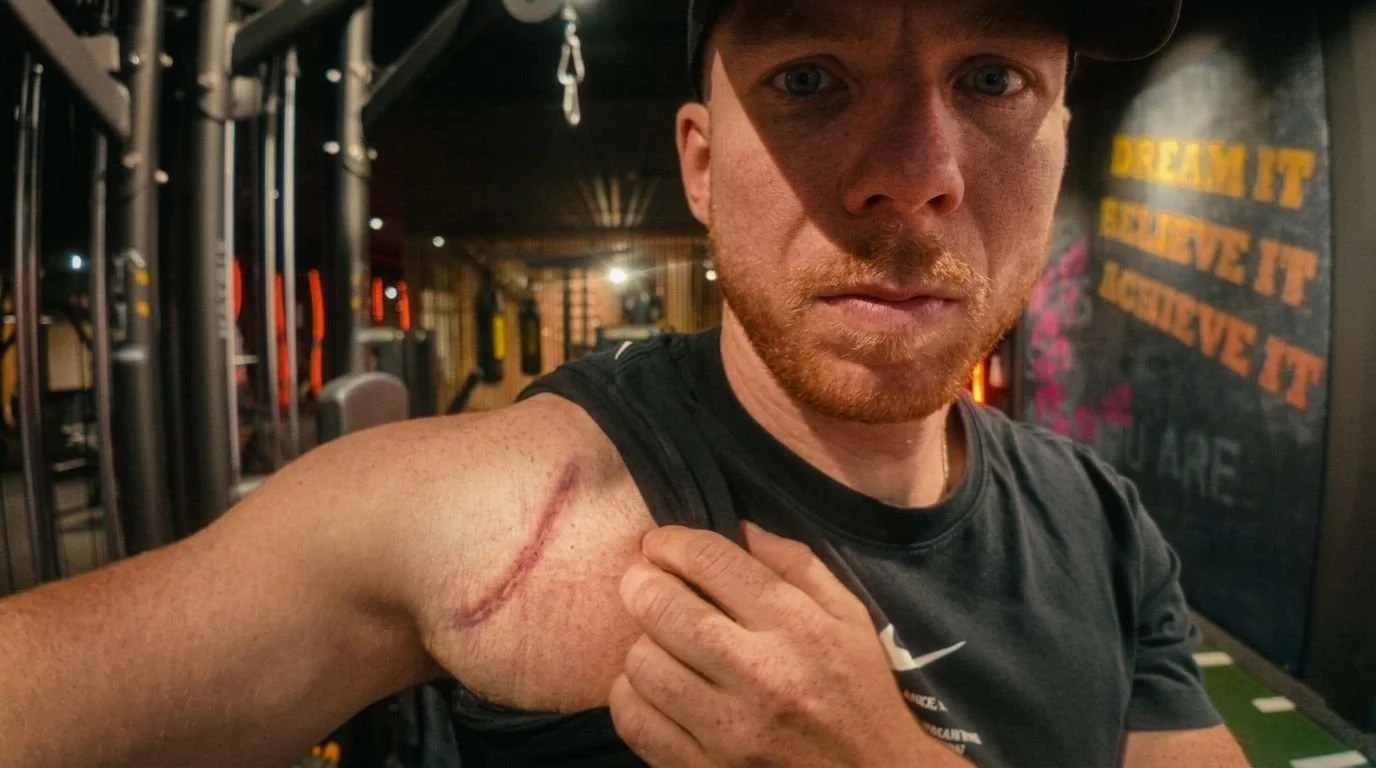
How am I doing 12 months post latarjet surgery?
A honest update
Voor Nederlands, KLIK HIER
One Year After Latarjet Surgery: My Honest Recovery Update
One year ago, on October 14th, I had my Latarjet surgery. Today my shoulder feels free. I can do pull ups, box and smash full power in padel again, and I don't think about dislocations anymore. But the road here was not only physical. This is my honest update on what the year looked like, what I learned, and what I would tell you if you are about to go through it yourself.
Why I went quiet for a while
I haven't posted in a few weeks, and I want to be honest about why. The YouTube grind took a toll on me this past year. I am the kind of guy who gets obsessed with things, and I caught myself thinking about content all the time. Every place I went, I was looking for a video angle instead of being in the moment.
The break did me good. Now I'm getting the ball rolling again, with one change. The Latarjet is interesting to talk about, but it is not my passion. So you will see more of my sports journey here too. I'm training for a half Ironman, and my shoulder plays a big part in that story. Sports, mindset and recovery all connect.
If you had the surgery, are deciding whether to do it, or you are a physio working with shoulder patients: welcome. Our free WhatsApp group now has around 160 people who have done the surgery or are planning it. Information on the Latarjet is hard to find, and the people in that group are kind and ready to answer your questions.
The surgery is successful, but complications are real
I'm still recording podcasts with people from the Latarjet community. One of my guests was a professional hockey player from Germany who had the same nerve damage I had. My nerve recovered fully, and I'm very grateful for that. His did not.
He now needs a second surgery called a neurolysis. That is what I would have faced if my nerve hadn't repaired itself. The surgeons open the area and check the nerve for damage along the "cable". If the damage is permanent, they take part of a nerve from the triceps and use it to bridge the damaged section, so it can take over the function.
So there is still hope for him. I'll have him back on the podcast after his surgery. I share this because the Latarjet has a high success rate, but complications do happen, and you deserve to know that going in.
The Latarjet Reset
Here is something I want you to think about. You don't have to take it as truth. The recovery period gives you a chance to stop, re-evaluate and rebuild your life. I call it the Latarjet Reset.
Not everyone gets this. Some people have to go back to work after one or two weeks. I couldn't. If you get that time, plan it before the surgery:
Which books you want to read and which documentaries you want to watch
How you want to eat and fuel your recovery
Your relationships, and what needs attention
Goals for the future: a trip, a language, a skill
That doesn't mean you can't game or eat junk food. I do it too. But if you use this window well, it can be one of the most fruitful periods of your life. It was for me.
Prepare for the war in your head
The mental side hit me harder than the physical side. I'm a very active person. I love sports and being on the move, and suddenly I was very limited. On top of that I had nerve damage, and my surgeon told me he didn't know if it would ever heal. The voices in your head during a period like that can be very damaging.
It's different for everyone, but for a lot of people it will be tough. Being prepared helps you get through it. If you have support from parents or a partner, that's great. If you don't, you work with what you have.
Some people have reached out to me who live with parents they have a bad relationship with. They're stuck at home after surgery and end up coping with drinking, drugs or smoking. Your shoulder is barely working, and life keeps happening around you: family, money, work, health. So prepare for whatever your situation is. Whether you are 20 or 60, change is possible.
Control the controllables
Could I have handled my recovery better? Probably. Am I satisfied? Yes. I did my best to control what I could control, and that is not much. You can't control how fast your body heals. You can control your reps, your nutrition and your habits.
Alcohol, smoking and drugs
People ask me about this a lot, and I don't judge. I used to do it all. About 12 years ago I was a drug dealer and ended up in jail. So I'm far from judging you.
But drinking is bad for tissue and muscle healing. Smoking is very bad. Drugs are not good for your arm and not good for your life. Forgive me for saying it, but I see it as wasting your life force. I know addictions are real, and I know some of you are coping with heavy things. I respect that.
Still, ask yourself what is worth more: your recovery and wellbeing, or the cigarettes, the alcohol, the pills. You don't have to go cold turkey. Make a plan to cut down step by step. Do your exercises, read, watch good content, work on yourself. Change now, and you will reap the benefits in the long term.
What my surgeon said about peptides
Before my surgery I asked my surgeon about peptides, which some people use to speed up tissue healing. A few guys at the gym had recommended them. His answer: not needed. Be patient and trust the natural healing cycle of the body. I fully agree, and I followed his advice.
I'm not a doctor and I have no scientific argument against them. I'm just a natural guy. I take supplements like magnesium and creatine, but no steroids and no peptides. In Belgium they're illegal anyway. The choice is yours, but be careful: you never know where that stuff comes from.
Stop comparing your recovery
One of the biggest mistakes I see, and I'm guilty of it first, is comparing yourself to other people. I was raised that way. I had to be the best at school, the best at soccer, the best at board games. Everything was win or lose. My parents love me and I love them, but this is something I still work on consciously.
With recovery it's tempting to watch my videos and think: he was doing this after one week, and I still have to wait six weeks before I can get out of the sling. Don't do it. It's not healthy after surgery and it's not healthy in life. Think win-win. Be happy for me, I'll be happy for you, and trust the protocol you were given.
Conservative vs aggressive rehab
There are different rehab philosophies. Some surgeons and physios are very conservative and build range of motion slowly. My physio was aggressive. He wanted full range of motion fast.
I won't say which one is better. For me personally, I'm grateful we went aggressive. My range of motion today is close to perfect, maybe a few degrees off, and I'm more flexible than most people.
If you have doubts about your approach, talk to your physio. Mine was young, super motivated and did a lot of research, and my process taught him things too.
Communication is key
Communicate with yourself, and with your physio, doctor and surgeon. You are not less than them. You are a human being going through a major surgery, so speak your mind and ask your questions. If something is still unanswered, bring it to the WhatsApp group.
My shoulder one year later
I'm satisfied and happy, and I would do the surgery again, even knowing about the nerve damage. Here is where I stand at 12 months:
Range of motion: close to full, a few degrees off
Gym: pull ups, dead hangs, lat pulldowns and face pulls with no pain, stiffness or fear
Padel: I had to relearn the smash. At first it felt bone on bone and I was scared, since most of my subluxations happened on that movement. Now I smash full power and it feels stable.
Kickboxing: I train now and then, without problems
Jiu jitsu: not yet. I'm a white belt and white belts make mistakes. I believe my shoulder would hold, but I don't want unnecessary risk.
I still lose some strength in external rotation. Band work hits that weak spot, and I don't enjoy it, but my physio is clear: keep doing it and it gets better.
The one thing I still feel
As a postman I sort letters into a wall of slots all day. After a while that motion makes my shoulder tired and I have to shake it off. Same when I hold my phone to my ear for 20 to 30 seconds, or when I shave my head.
It doesn't limit me in the gym or in my sport. If anything it's a reminder. I only think about my shoulder when I feel it, and that tells me the recovery went well. There is still room for improvement if I stay consistent with my exercises. But the goal has been reached: I'm free from the fear of dislocations.
What's next
I'm focused on endurance now. Next year I want to do a 70.3, a half Ironman with swimming, cycling and running. My ego wants to go fast, but I'm building the foundation level by level. A VO2 max test on the bike is coming soon, and I'm also working on dropping from 77 to 70 kilos. I'll share both on the channel.
Thank you to this community
If you're going through a hard time right now, know that I'm here for you and the group is too. In all honesty, this community is one of the most beautiful things to come out of my surgery. People are kind, helpful and really in this together.
This is not about me. I'm just like you, sharing my testimony online. You are as valuable as I am and as valuable as anyone in this community. Thank you for everything you've done for me. We are building this together.
God bless.
Dylan
Checkout our latarjet rehab program
Youtube Video: FAQ session with my physiotherapist